


What makes pepper spray work.
Every can lists some mix of OC percentage, Scoville heat units and major capsaicinoids. They measure three different things. Here’s what each one means, what’s inside the can, and how to check a spray’s strength for yourself.
How much pepper resin is in the formula
The heat rating of the resin before it’s diluted
The heat that’s actually in the can, lab-tested
The same formula in every POM pepper spray.
Three ingredients, each with a job.
Every pepper spray is built from the same three parts. The formula decides how strong it is, how cleanly it sprays, and how easily it washes off.
Active ingredient: oleoresin capsicum (OC)
A resin extracted from chili peppers. The capsaicinoids inside it cause the burning and involuntary eye closure. POM uses pharmaceutical-grade, ultra-refined OC.
Carrier
Keeps the OC suspended and shapes the spray pattern. Many brands use alcohol or solvent carriers. POM’s is water-based, which makes cleanup easier.
Propellant
The pressurized gas that drives the formula out of the can, with enough force and range to reach its target.
The POM formula, drawn to scale. It’s the same in every unit.
The bottom bar zooms into the OC. About 14% of the resin is capsaicinoids, and that share decides how strong the spray is. Two sprays can hold the same amount of OC and deliver very different heat.
Three numbers, three different jobs.
Think of OC as the amount, SHU as the potential heat, and MC as the measured heat. Only MC tells you how strong the finished spray is.
| Number | What it measures | How it’s measured | Where it misleads | POM |
|---|---|---|---|---|
| OC %The amount | How much pepper resin is in the formula, by weight or volume. | Set by the manufacturer’s recipe. | It says nothing about how potent the resin is. An 18% OC spray can still be weak if the resin is low-grade. | 10% |
| SHUThe potential | The heat rating of the raw resin, before it’s diluted into the can. | Originally a taste test. Today a lab measures capsaicinoids and converts the result. | A big SHU on a label rates the resin, not the spray. Diluted down to a few percent OC, even very hot resin makes a milder spray. | 2.12M |
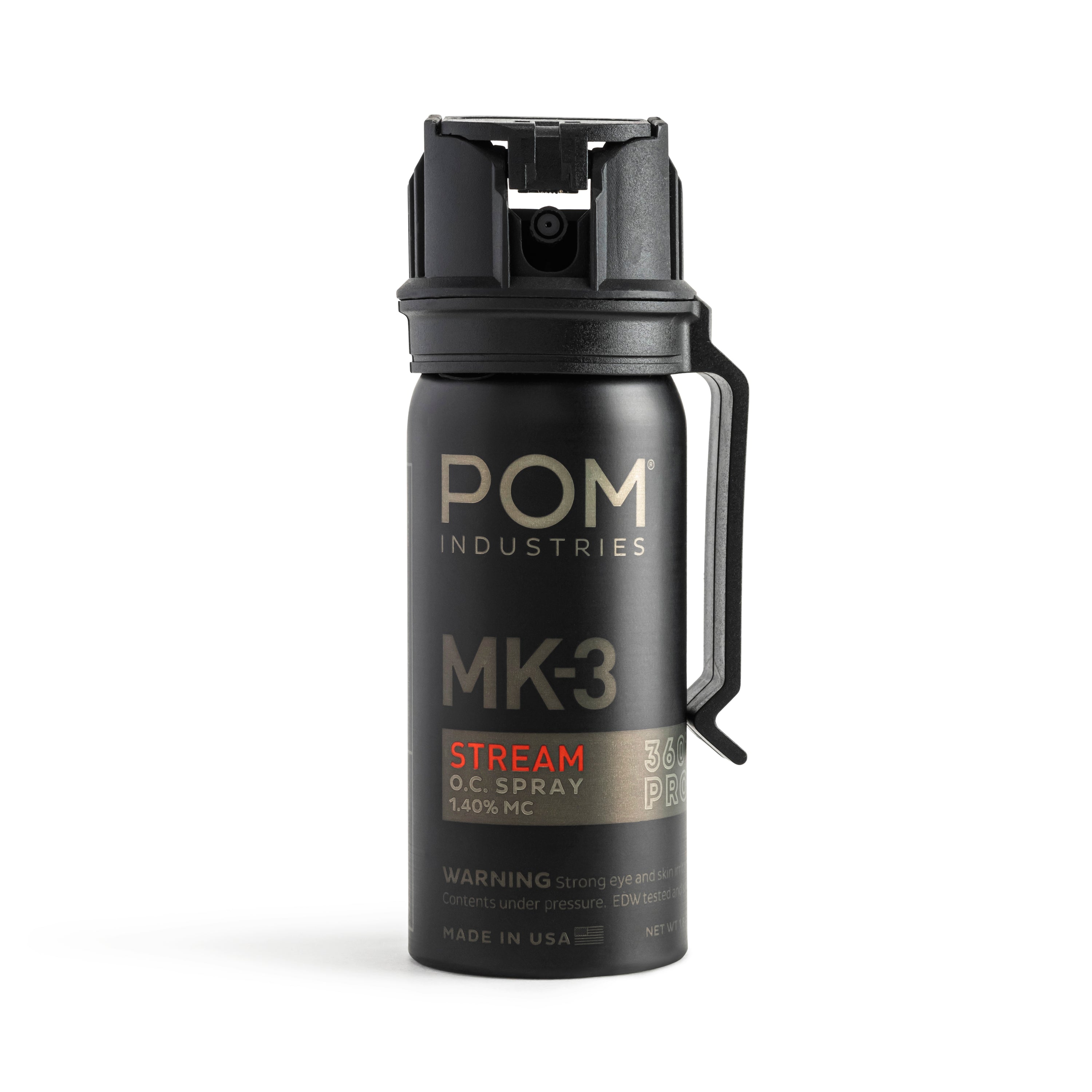
| MC %The measured heat | The share of the finished formula made up of the compounds that burn. | HPLC (high-performance liquid chromatography), which counts each capsaicinoid directly. | Rarely. The catch is that many brands don’t publish it. If a can doesn’t list MC, ask. | 1.40% |
How OC and SHU add up to MC.
Multiply the OC percentage by the resin’s SHU and you get the heat in the finished spray. Divide that by 150,000 and you have a close estimate of MC. That’s why a big number on one side of the label can hide a small one on the other.
Each line is resin with a different SHU rating. Where a spray lands depends on both numbers.
A and B are illustrations, not specific brands.
Check any spray.
Enter the OC percentage and SHU from a label. Your result shows on the chart as a dashed circle.
That’s past the edge of the chart, so the circle sits on the border.
Pure capsaicinoids rate about 15 to 16 million SHU, so 1% MC is roughly 150,000 SHU in the finished spray. Treat the result as an estimate. Only HPLC testing gives the exact MC.
The compounds that do the work.
Capsaicinoids are the family of compounds that make chili peppers hot. They’re what MC measures.
Capsaicin and dihydrocapsaicin carry most of the heat. Together they make up roughly 90% of the capsaicinoids in most chili peppers.
| Compound | Source | Role |
|---|---|---|
| Capsaicin | Natural | The best known, and a main source of the heat |
| Dihydrocapsaicin | Natural | Capsaicin’s closest partner, with similar heat |
| Nordihydrocapsaicin | Natural | A smaller contributor |
| Homocapsaicin | Natural | A minor component |
| Homodihydrocapsaicin | Natural | A minor component |
| PAVA (nonivamide) | Synthetic | A lab-made relative of capsaicin. Some sprays use it, and some sources count it as a sixth |
Putting 2.12 million SHU in perspective.
In 1912, pharmacist Wilbur Scoville rated peppers by how far an extract had to be diluted before tasters stopped feeling any heat. Labs now measure capsaicinoids directly and convert the result. The scale climbs fast, so each step on this chart is ten times the last.
POM’s resin sits alongside the world’s hottest peppers. Diluted to 10% in the can, the spray lands in habanero territory, concentrated into a stream aimed at the eyes and face. That’s why MC, not the resin’s SHU, is the number to compare.
Every batch, tested and traceable.
A number on a label is only as good as the testing behind it. Here’s how we make sure 1.40% means 1.40% in every can.
- 1
Refined resin
Pharmaceutical-grade, low-color OC with waxes and impurities removed before it reaches us.
- 2
Water-based formula
Water-soluble OC means no harsh solvents. It’s clear, not red, and washes off more easily.
- 3
HPLC on every batch
Each production batch is tested to confirm its 1.40% MC.
- 4
Independent verification
Third-party labs confirm our results, so we’re not grading our own work.
- 5
A batch number on every unit
Each can traces back to its raw materials and test records.
Color isn’t heat. A deep red spray usually means less refined resin, not a stronger one.
Made in USA | ISO 9001:2015 Certified
Learn it well enough to teach it.
This page covers the basics. The POM OC Instructor Course takes you through the full science, safe use and training, so you can teach others with confidence.
In the course
- How OC affects the body, and how long it lasts
- OC compared with older tear gases
- How to judge a formula and spot misleading claims
- Safe carry, deployment and aftercare
Common questions.
What does 10% OC mean?
10% of the formula is oleoresin capsicum, the pepper resin. The rest is the carrier and propellant. It tells you how much resin went in, not how strong the spray is.
Is a higher OC percentage stronger?
Not necessarily. A smaller amount of potent resin can beat a larger amount of weak resin. Compare MC instead.
If a spray is rated 2 million SHU, is the spray itself 2 million SHU?
No. The rating describes the resin before it's diluted. At 10% OC, the finished spray is about a tenth of that.
Why is POM's spray clear instead of red?
We use ultra-refined, low-color resin. Red color mostly comes from waxes and plant matter that don't add heat.
Find the POM that fits how you carry.
The same 1.40% MC formula in every POM. Pick your carry and your color.
Shop POMSources: Pepper heat ranges from published Scoville tables. Capsaicinoid composition from published HPLC analyses of chili peppers. POM figures from POM’s batch testing.